
Obsessively putting our comics in chronological order since 1985.

| 1978-04-01 00:01:05 |
| Previous: Peter Parker, the Spectacular Spider-Man #16 | Up: Main | Next: Spider-Woman #1 |
Captain America #217-221
Issue(s): Captain America #217, Captain America #218, Captain America #219, Captain America #220, Captain America #221
Cover Date: Jan-May 78
Title: "The search for Steve Rogers!" / "One day in Newfoundland!" / "The adventures of Captain America!" / "The Ameridroid lives! / ...On a wing and a prayer!" / "Cul-de-sac!"
Credits:
Roy Thomas & Don Glut / Don Glut / Don Glut, Steve Gerber, & David Anthony Kraft - Writer
John Buscema / Sal Buscema - Penciler
Mike Esposito & John Tartaglione - Inker
Scott Edelman - Writer on issue #220 back-up
Bob Budiansky - Penciler on issue #220 back-up
Alan Gordon - Inker on issue #220 back-up
Review/plot:
This was supposed to be Roy Thomas' run on Captain America, but Don Glut is brought in as the exclusive "guest writer" almost immediately. Roy Thomas is just "Editor" after issue #217, and we also have Archie Goodwin as "Consulting Editor". And then issue #221 is by Steve Gerber and David Anthony Kraft (and the UHBMCC cites two sources saying that Glut did the plot for the first 5 pages, which were intended for the end of issue #220 but the artwork was lost, also resulting in back-ups for issues #220-221). Basically what you might call a big mess. And unfortunately this is all around some major retcons that, if someone really felt necessary to do at all, should have been done with greater attention or at least a consistent creative team.
I don't have Roy Thomas' debut in Captain America #215 (but god help me, i'm going to need to get it to confirm some of this for myself) (added it) (and issue #216 was a fill-in reprint issue, btw), but we get some clues about what's happening here from a letter in issue #219.
The letter writer, Robert Bruce Braley, quotes Steve Rogers, from issue #215: "I was alive, and in a state of suspended animation which, even today, I can't explain." Braley continues, "It's been pretty firmly established that the ice was what kept Steve in suspended animation (no matter how unlikely that seems), while the super-soldier serum kept him alive."
Marvel responds:
It hasn't really been firmly established that ice kept Cap alive for two decades. That's just what everyone has assumed. Actually, it was probably the peculiar interaction of the ice on his super-soldier body which did it... and the mere fact that Steve Rogers survived hardly means he could explain his survival.
If you thought that was some really unnecessary parsing, i'm right there with you. The solution to this "problem" is going to be worse than you can imagine, however.
Braley (the issue #219 lettercol consists entirely of his letter and Marvel's response) also gives us a clue on the reason for the upcoming Steve Gerber retcon (concluding in issue #225) as well. He quotes Cap from #215 again:
When I was trying to remember my past - who I was before I walked thru that door to drink the super-soldier formula at the age of 20 back in '41 - I suddenly realized - that I didn't know!
Braley reminds us that Captain America #176 did indeed show some of Cap's childhood. He also notes some errors regarding the date and age when Rogers became Cap. But to me, the real question is why is Roy Thomas trying to establish that Steve Rogers has some kind of mysterious, forgotten, past? The response is that this will all be explained. But believe me, we won't like the explanation.
So we start out with Captain America and the Falcon heading to the SHIELD HQ to begin the investigation on Cap's lack of memories. Thomas brings back the barber shop from the Strange Tales days, although the way they operate suggest they're not too concerned about blowing their cover.


Nick Fury tells Cap and Sam that they're working out the details on the Corporation, which was introduced at the end of Jack Kirby's run.
Fury also reveals that SHIELD has assembled their own group of Super-Agents to fight the Corporation's super-agents (such as the Night Flyer). The group is on the uninspired side, including two new characters, Blue Streak, and Vamp.


Blue Streak is a roller-skate themed hero, and i think that's all i need to say about that. Vamp (It's said that Fury originally wanted to call her "Femme Force") is less gimicky, and doesn't even have a real costume. She's got a belt that lets her use the powers of her opponents against them. There will later be a much more interesting revelation about her that i'm going to spoil now: she'll turn out to actually be one of the Corporation's super-agents, the creature called Animus.
The other two characters are from Roy Thomas' Fantastic Four run.


The Texas Twister was part of the weird 'Frightful Four recruitment drive' story in Fantastic Four #177. And Marvel Boy is also a new character, but he's based on the original 1950s version (or "the 1950s Super", as he weirdly puts it) that Thomas brought back and then killed off in Fantastic Four #164-165. He's called Marvel Boy in issue #217, and then Marvel Man after that. He'll eventually get revamped as Quasar, a character with some real longevity. But right now it's just Thomas' Golden Age obsession showing through (there's not even a direct connection between this character and the original; it's said that he got his powers from "Tony Stark's crew". It'll later be said that he received the power bands of the one who died in that Fantastic Four arc.)
Fury wants Cap to lead the Super-Agents of SHIELD. When Cap refuses, a fight breaks out.


After a few pages of fighting, Cap calls it off, revealing that he was just testing them. It was pretty stupid of Cap to start a fight like that, and i suspect that later writers have a little mocking fun with it, because the next like 6 times that these guys meet Cap again, they inevitably get into an argument and then start wondering if Cap is trying to test them again, and a fight breaks out. As it is, though, Cap suggests that the Falcon lead the team.

Overall, the Super-Agents are a logical idea and a lot could have been done with them. The Falcon as leader/trainer had potential as well. Unfortunately, nothing really gets done with them, and the Falcon portion of the plot is abandoned almost immediately.
Anyway, Cap leaves SHIELD and we see that he's being observed by the Corporation, specifically Kligger and Veda from the Kirby story in #213.

Veda runs up to Cap, setting up a situation where it looks like he's two-timing Sharon Carter. Then they are attacked by goons in green and orange costumes.

Veda reveals that she knows Cap's secret identity, and he takes her to the Avengers Mansion to find out why. It turns out she is the daughter of a woman that Cap knew in World War II.
Iron Man walks in on them as they're getting a little close, and IM mistakenly calls her Sharon, setting off an uncomfortable moment.

Meanwhile Sharon heads to SHIELD headquarters, looking for the Falcon. She finds him training the Super-Agents.

Iron Man mentions that he's got some work to do on the old Avengers submarine. This is the sub that the Avengers were on when they found Cap way back in the beginning. Cap leaves Veda behind (the sub is off limits to civilians) and pokes around in the sub until he finds a tape of the events of that day and hears that he was found off the coast of Newfoundland. Apparently that's important, although i'm not clear why. He was in Europe, Zemo launched an experimental airplane, and thanks to the final efforts of Cap and Bucky, the plane crashed somewhere on the way to America. Cap's body was frozen. Newfoundland is as good a place as any for it to pop up again. But Cap thinks it's a clue and decides to go to Newfoundland.
He runs into goons similar to the ones he fought earlier. They're wearing purple and yellow instead of orange and green, but it's the same style.
While he's fighting the goons, he casually mentions that his super-strength has faded away and he's back to his old power levels.

I suppose this is more of a confirmation than a revelation. Writers (especially Kirby) have basically been ignoring his super-strength for a while.
After fighting his way through the goons, he encounters a General Dekker. It's someone that he's met before, but he doesn't remember the details due to an unexplained explosion. Dekker has created a giant Captain America robot.

I originally read issue #218 without owning the surrounding issues. And in my original review i wrote this (but i didn't really believe it):
I'm not sure where they're going with this. It seems like they're suggesting that Cap had been dethawed from the ice sometime in between the fight with Baron Zemo and then was subsequently refrozen. That would be a bad move.
That is indeed where we're heading, but first, issue #219 takes one of Roy Thomas' world famous detours. It's all about the first time Cap met Drekker, during World War II. The issue is, i guess, a tribute to the Captain America movie serials published during WWII.

The characters run through some objections about how the movie differs from reality (you can read about the differences in the Wikipedia entry i linked to, too), and then circumstances cause the real Cap to have to play himself in the serial. The special effects guy is Lyle Dekker, and he turns out to be a Nazi saboteur. Dekker is presumed drowned at the end of the flashback. Since then he's been in Newfoundland working on his Ameridroid.
The cover of #219 indicates the Corporation is involved with the filming of the movie, but that's not true. They weren't even around in the 1940s when the movie was being filmed.
With that out of the way, we can get back to ruining Captain America's Silver Age origin. The story is that the plane that Cap and Bucky were on crashed over the English Channel (the first version of this story, in Avengers #4, states clearly that Cap struck the water over the coast of Newfoundland, but i think this whole retcon is because Thomas doesn't think that was feasible) and then Cap was retrieved by Drekker's men and brought to Newfoundland. Cap fought his way past Drekker's goons and then escaped in a plane loaded with nerve gas. The plane was then shot down and Cap falls into the waters off Newfoundland. It was the nerve gas, you see, that put Cap in suspended animation (and also removed his memories of the incident).

And now we have "explained" something that never needed any explaining. I really don't get it. This story dilutes the original Silver Age origin, which was powerful and simple: Cap and Bucky were seemingly killed stopping a dire plot by Baron Zemo. Cap was later revived. Full stop. Now Cap is saddled with repressed memories and the fact that he had two major failures within a short period of time. Why? Whyyyyyyyyyyy?
From there, on to the Ameridroid. Drekker drains Captain America's super-soldier "energy" and abilities...

...and puts that and his own mind into the giant Cap robot. He goes on a little rampage in Newfoundland. The bizarreness of this, illustrated competently by Sal Buscema, almost makes up for the terrible retcon that got us here.


But then Drekker realizes he feels like a freak inside the body of a giant Captain America robot and gives up, which is a nice twist by Gerber, who has now taken over the writing.
The main story ends with Cap returning home to his apartment and falling asleep after realizing that the adventures and revelations he had in Newfoundland haven't resolved his pre-Captain America memory loss issues, which should scare us because it means even more retcons ahead.
In the back-up for issue #220, the Falcon fights a new villain who has kidnapped his bird, Redwing.

The villain, Mortimer Freebish, is deliberately depicted as a loser - he winds up defeating himself by shooting a blinding "Opti-arrow" while forgetting that he's not wearing protective eyegear. He also can't decide if he should call himself Arrowsmith or Arrow Ace, and thinks he's on his way to becoming the "greatest super-villain this side of Dr. Doom".
I guess the story's meant to be humorous, but despite the attempt, putting the Falcon up against this guy is just demeaning to everyone.
So, in summary, a really pointless and damaging retcon by a semi-absentee Roy Thomas, but we do get Quasar and the Ameridroid out of the mess.
Quality Rating: D+
Historical Significance Rating: 6 - first Quasar (as Marvel Boy/Marvel Man), Cap's super-strength is gone, first Ameridroid
Chronological Placement Considerations: The MCP places this arc after the Korvac saga, but there's a footnote in that series that references Captain America #218's confirmation that Cap has lost his super-strength, so i prefer to place these issues prior to that.
I've placed this arc after the Texas Twister's appearance in Fantastic Four #192, but only because it would otherwise ruin the surprise or mystery of seeing the Twister as a good guy. Otherwise there's no reason why he couldn't have appeared in FF after here, since we'll learn he was acting as an agent of SHIELD in that issue.
Despite the fact that the Falcon seems to be back on the streets and not working with the SHIELD Super-Agents in issue #220's back-up story, the MCP places him there directly after his appearance in Cap #218. Cap will soon learn that the Falcon abandoned his position as leader of the Super-Agents.
The back-up in issue #221 takes place between Avengers #14 and #15. I've placed an entry for that in its proper spot.
References:
- SHIELD uses a machine to project the thoughts of a traitor to SHIELD who was captured in Captain America #213-214.
- Surprisingly, neither the Texas Twister nor Marvel Boy get any footnotes regarding the Twister's previous appearances or the original Marvel Boy. But the Twister appeared in Fantastic Four #177 and Fantastic Four #192. And the original Marvel Boy first appeared in Marvel Boy #1 and was later brought back by Roy Thomas in Fantastic Four #164-165.
- Cap has been obsessed about figuring out some inconsistencies in his origin story since Captain America #215.
- Apparently back when Captain America was found in Avengers #4, it was off the coast of Newfoundland.
- Captain America received super-strength as a side effect of the Viper's poison in Captain America #157.
- Wrapping up this arc, Cap thinks to himself that Steve Rogers expired after his brief career as a New York Cop. The footnote is vague, but Cap's last appearance as a policeman was Captain America #152.
Crossover: N/A
Continuity Insert? N
My Reprint: N/A
Inbound References (13): showCharacters Appearing: Ameridroid, Animus (Vamp), Blue Streak, Captain America, Dum Dum Dugan LMD, Falcon, General Lyle Dekker, Iron Man, Jarvis, Kligger, Nick Fury, Quasar, Redwing, Sharon Carter, Texas Twister, Veda Previous:
Peter Parker, the Spectacular Spider-Man #16Up:
MainNext:
Spider-Woman #1
Comments
The Falcon disappears from the book for quite a while after this issue. Sharon Carter had previously disappeared for over a year just prior to, and during, Kirby's run.
Don Glut was continuing a plot started by Roy Thomas during his extremely brief time on the book. Steve Gerber would take over quickly from Glut,and stay just briefly enough to make the "Cap's mysterious past" plot an even bigger mess.
"Hero" probably just fell off that one word balloon of Marvel Man's by accident during production. And thanks to the continuing Alan Moore Marvelman/Miracleman various legal dramas, everyone's forgotten that that was Quasar's original superhero name.
Quasar was supposed to get a Marvel Premiere of his own in late 1979 explaining how the wristbands worked, but it never happened.
Cap's new origin appears to have been immediately forgotten. In one of the letter pages, a reader notes that after he was revived by the Nazi, Cap should have been sad that Bucky died as he was in Avengers #4.
Not sure if it was the same letter, but in a letter column Marvel admitted that it wasn't Cap in that flashback.
FOOM#19 stated that Roy Thomas intended the SHIELD Super-Agents to have their own book.
I've learned today that there is a way to make the Texas Twister seem pretty cool:partner him up with a blue guy in roller skates.
Also Stark must have been hitting the bottle if he got confused a redhead, well orange, with blonde Sharon.
Well Roy Thomas at least solidified one thing about Cap: the reason he got frozen was bad and he ruined a few other things but at least he probably gave the '07 movie the idea of Cap as a movie serial star.
The actual problem that Roy is trying to solve was introduced in Avengers #4.
Cap never made it onboard that rocket-plane, yet he himself says that he fell into the water off the coast of Newfoundland, thus the "revelation" here should have been nothing of the sort.
The only "mystery" was how Cap jumped off a motorcycle in Europe, failed to grab hold of the rocket-plane, and fell into the water near Newfoundland. That's some serious hang time.
Unfortunately, in the meantime Roy had written scenes showing Zemo (not ID'd in Avengers #4) celebrating his success, so Roy couldn't just retcon that Cap made it aboard the plane and later fell off, as you suggest. The explosion had to have happened where Zemo could witness it, although in retrospect that would have been a far less painless retcon (simply have Zemo witness the explosion via some tracking instrument). There's also the problem that such prolonged exposure would have killed Bucky for sure, but that could have been explained by having Bucky gain access to a cockpit or some other protected area.
Unfortunately, that introduces the problem that Cap must have definitely made it aboard, which means that Bucky spent a considerable amount of time trying to reconfigure the plane. So why wouldn't Cap have tried instead? It still could make sense if you figure that there was just a small cockpit and Cap knew that trying to exchange places with Bucky would kill him and he felt that Bucky actually had a chance of taking control of the craft and bringing it down safely somewhere.
But Roy being Roy, he had to decide there was a bigger story here, even though his idea meant ignoring Cap's original statement that he knew he was off the coast of Newfoundland when the plane exploded.
Jesus Christ, Roy Thomas. Know when to stop.
Going through this site and re-reading some old comics (both Marvel and DC) have served to make Thomas my own personal nemesis. It's sad because HE TRIES SO HARD to "fix" the Marvel Universe but nine times out of ten he's just applying invasive surgery to minor scrapes.
Not to be a pain or anything, but shouldn't the Falcon back-up be put at a different point. At this time Falcon is training the Sheild super-agents on the west coast. The back-up has Falc in NY with clearly no affiliations. Wouldn't make sense for him to jaunt back to NY just for this story.
the reason Cap abandoned his position as leader of super-agents was he got kidnapped, right?
Correction: Falcon, not Cap
My rule for back-ups is that if they can possibly fit circa the main story, i keep them there, even if it's not the best possible placement. I prefer to not cut the books up.
In this case, though, the Facon has a few other appearances that i and the MCP place between this arc and his reappearance in this series in Captain America #230. He appears in Marvel Team-Up #71 (which also features Captain America and Nick Fury and which the MCP place between Captain America #221-222), and in the "everybody's a Defender" story from Defenders #62-64. So he must have been with the Super-Agents for a while, and also doing some side missions, before getting kidnapped prior to Captain America #230. And so fitting the back-up here (as the MCP does also) doesn't seem to be a problem.
gotcha. makes sense.
The letter column from #217 clarifies how the Thomas/Glut thing was meant to go down:
https://40.media.tumblr.com/007ea9179f0ccb411f8e15b00f16fbdf/tumblr_o50fstrrE61tms107o1_500.jpg
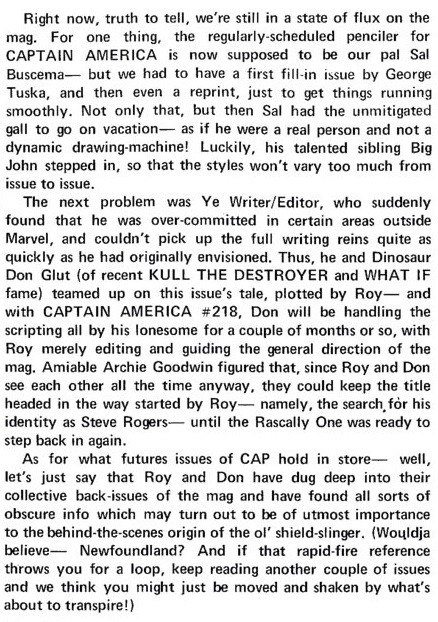
It sounds like at the time there were a lot of behind-the-scenes problems on this title, which is par for the course for late 1970s Marvel.
When I was in high school in the early 1990s I was on a quest to assemble as complete a run of Captain America back issues from the 1970s and 80s as I possibly could. I distinctly recall that when I acquired these issues from the year or so immediately following Kirby's second run I was very underwhelmed by them. They were very rambling and unfocused and full of extremely unnecessary retcons and dropped subplots.
All these years later I am still curious about who the heck Veda was supposed to be and what really happened to her mother. I wonder where Thomas and Glut were actually going with the character. Maybe they were just making it all up on the spot? All I know is that when she is subsequently murdered by Kligger that plotline was totally dropped.
The Ameridroid is one of the most ridiculous concepts to ever see the light of day, and I do not mean that in a good way. The only thing worse than it is the pointless retcon that inserts Cap's adventure in Newfoundland in between the drone plane explosion and Cap going into suspended animation.
Looking at these issues, and some of the other stuff going on at Marvel during this period, it is apparent that someone like Jim Shooter was needed to bring some much-absent organization to the company. Admittedly at times he ended being too rigid and lacking in interpersonal skills, and alienated some good creators. But without him it's possible that Marvel would have gone under. As I recall, the only thing that really kept them from going out of business in the late 1970s was that they made a ton of $$$ from the Star Wars comic books.
Currently reading this reviled moment of Cap history and having just finished Cap #222 and #223, which are covered in a different entry but since you brought Veda up here... I've gotta say it definitely reads like it originally was someone's plan that Animus was Veda.
There's a lot of evidence to support that in the issues. Veda is also in Washington conveniently when Animus is there and attacks Captain America. She shows up at Cap's apartment after the battle - having a lot of knowledge about Cap's location and circumstance (although, it's shown the Corporation have Cap bugged too - which is just as easy an explanation for these coincidences since Veda ISN'T Animus).
The more obvious bit is later on when Veda alerts Kligger to the train Cap is returning to New York on to which Kligger declares that Cap is to be executed. Veda doesn't respond by moaning about not having the chance to personally kill Captain America (as she has done almost every other time) and then when Cap defeats Animus the second time we have a sequence that stresses that Animus cries out in a woman's voice. And she's calling out Kligger's name and by this point Veda is pretty much the ONLY character who's being depicted as even knowing Kligger.
Obviously things didn't go down anything close to that and Veda turned out to be utterly irrelevant and unresolved. But reading those issues it definitely seems that Gerber (or maybe leftover notes from Glut or Thomas) had the intention of Veda being this Animus. I'm not sure when the 400th creative team shake-up happens and McKenzie takes over, so I'm not sure if Gerber later contradicts this idea or what, but it's definitely something that stood out to me as a reader.
Although Gerber did just kill her off in the very next issue, so I'm guessing it either wasn't his idea or wasn't even meant to be thought by readers.
One other thing to note, though, is that one of the issues of Gerber's run was dialogued without Gerber seeing the art, as Mark Evanier described in a post on rec.arts.comics.misc on 3/31/99:
"Before FedEx and fax, it was worse.
There's an issue of CAPTAIN AMERICA that I helped S. Gerber dialogue.
The pencils came in and the book was so late that there was no time to
send them out here. So someone in the Marvel office DESCRIBED the art
to Steve over the phone...and we wrote the balloons and captions
without seeing the actual pages. Always fun."
Wow. I have never heard about the book being so ridiculously behind schedule that someone had to dialogue it without even seeing the artwork. That is absolutely insane.
I have to reiterate my comments about Jim Shooter here. As much as Marvel in the 1970s saw some really off-the-wall innovation, it was more often than not a train wreck when it came to getting books out on time and producing material of a consistently good quality. Shooter really whipped the organization into shape, and some of the best material Marvel ever published was under his tenure as EIC in the early 1980s. I think that if Shooter had departed from the company in say, 1984, before X-Factor, Secret Wars II and the New Universe, he would be much more fondly remembered today.
By the way, AF, very interesting theory about Veda being Animus, at least as was originally intended. As you lay it out, this actually makes a lot of sense. I think I've heard that idea floated before, maybe on one of the other entries here on fnord's site. Actually, even as it played out in the actual published stories, Veda could still have been Animus, and after Kligger murdered her the Animus power could have been transferred to Vamp.
But, yeah, I don't think that Vamp was originally intended to be Animus. As was indicated by Mark Drummond, it was Roy Thomas' desire that the SHIELD Super-Agents would get their own series, so I really doubt that he planned for half of them to be revealed as double agents for the Corporation. But, then again, who knows?
I'm almost tempted to e-mail Thomas or Don Glut to ask what their original plans were for all of these characters, but I seriously doubt that they're going to remember any of the details 38 years later.
AF- I agree on your Veda/Animus theory, it makes more sense than Vamp/Animus (who would somehow have to skip training and sneak to Washington). I wonder why it changed (other than due to the changing writers). However, if Ben Herman wants to email Roy I'd be interested. Roy seems to have a pretty good memory for old storylines, judging by his recollections on old Conan comics.
Roy and his teams. He always seemed to think of team concepts, like the Liberty Legion and Super agents, and then fill them with the most boring characters possible. Almost like the reader would be sold on the concept alone.
God fucking damn it, Roy Thomas. You really had to concoct all this nonsense just because you couldn't conceive of an airplane making its way from England to Newfoundland? Really? THAT'S what stretches the believability of a WWII super-soldier fighting Nazi robots, jumping onto a rocket, surviving an explosion, and being frozen for twenty years before being thawed out by a giant and a chick with antenae? It's the Newfoundland part that ruined the fantasy for you?
"Wrapping up this arc, Cap thinks to himself that Steve Rogers expired after his brief career as a New York Cop. The footnote is vague, but Cap's last appearance as a policeman was Captain America #152."
Amazingly, Steve Rogers will reappear as a policeman in Captain America #232 (1979), in uniform, and with the same supporting cast as before. Just for one issue.
' "Hero" probably just fell off that one word balloon of Marvel Man's by accident during production. And thanks to the continuing Alan Moore Marvelman/Miracleman various legal dramas, everyone's forgotten that that was Quasar's original superhero name. '
DC also had a forgotten Marvel Man who appeared in Action Comics #272-273 (1961), in a 2 part Supergirl story, where Supergirl meets her parallel world counterpart named Marvel Maid.
