
Obsessively putting our comics in chronological order since 1985.

| 1984-04-01 00:05:10 |
| Previous: New Mutants #15-17 | Up: Main | Next: ROM #53 |
Marvel Super Heroes Secret Wars #1-12
Issue(s): Marvel Super Heroes Secret Wars #1, Marvel Super Heroes Secret Wars #2, Marvel Super Heroes Secret Wars #3, Marvel Super Heroes Secret Wars #4, Marvel Super Heroes Secret Wars #5, Marvel Super Heroes Secret Wars #6, Marvel Super Heroes Secret Wars #7, Marvel Super Heroes Secret Wars #8, Marvel Super Heroes Secret Wars #9, Marvel Super Heroes Secret Wars #10, Marvel Super Heroes Secret Wars #11, Marvel Super Heroes Secret Wars #12
Cover Date: May 84 - Apr 85
Title: "The war begins" / "Prisoners of war!" / "Tempest without, crisis within!" / "Situation: Hopeless!" / "The battle of four armies!" / "A little death..." / "Berserker!" / "Invasion!" / "Assault on Galactus!" / "Death to the Beyonder!" / "...And dust to dust!" / "...Nothing to fear..."
Credits:
Jim Shooter - Writer
Mike Zeck / Bob Layton - Penciler
John Beatty / Jack Abel, John Beatty, & Mike Esposito - Inker
Review/plot:
Bob Layton is on pencils for issues #4-5 only. Issue #8 has the extra inkers.
Why do i keep my comics organized in such a strange fashion, instead of alphabetically by title like a sane person? Why do i have an entire website dedicated to figuring out a good reading order for Marvel's comics? A lot of the answer is due to Secret Wars. I started collecting comics while this series was coming out, and i wound up with a lot of issues that showed various characters going to and coming back from Secret Wars. So from the beginning it was clear to me that all those various comics were part of the same story (i.e., the same "universe"), and that the Secret Wars series belonged in the middle of those issues. So i started putting my comics in an order where i could read it all through as one story (in the early days, i could read through my entire collection in a short period of time). And i stuck with that as my comic collection grew. It certainly became more unmanageable over the years, and events weren't always as clear-cut as the issues that i started with, but it was doable. So here we are.

Actually, since i was only 9 years old when these books were coming out, it couldn't really be said that i was "collecting" comics yet. My parents brought me comics when i was sick or on other special occasions. Beyond that, my fledgling hobby was dependent on somehow making it to a store that sold comics while i had allowance money in my pocket. Didn't happen too often in the beginning. But the fact that all of these various books related to each other had a real appeal to me in a way that other comics my parents gave me, like DC or Disney comics, didn't. So i was pretty much an exclusive Marvel fan from the beginning.
Because of my limited access to new comics, my first issue of Secret Wars was #6. Awesome cover, with all the villains leaping out at you. Inside, lots of characters referring to events that i had no insight into, but to me it was an intriguing challenge to decode all of that. Next i was able to use some birthday money to buy a 3 pack at Toys R Us that had issues #4, #5, and #6 again. So two more comics for me (and one to trade). Then somehow i managed to get issues #8 through #12 on my own as they came out. Good thing about issue #8 because for a while that was a collector's item due to the first appearance (sort of) of Spider-Man's new costume. It took years before i filled in the gaps. Issue #1 was also priced out of my reach for a while. Now you can get the whole series in the quarter bins.
And that brings me to this series' reputation. There are several layers to get through. First, the rise of indie and Vertigo comics has subsequently shown us how comics can be more than super-hero slugfests. So fans of such stories (as i am) may find themselves looking down on comics like this. But i also like super-hero slugfests! And this is a good one! Critics from that angle are just as likely to not like any Marvel comics, so that's not really worth defending against too much.
Beyond that, the Secret Wars series was originally devised as a tie-in to a toy line. So that tends to make people dismiss it ("Oh it was just an advertisement for the toys!"). But as we'll see, this series makes a serious effort to tell a relatively complex story with decent character development (compare to DC's Super Powers mini-series).
As far as concessions to the toy line, there are barely any. The first is that Dr. Doom's armor is modified to match the toy.

But that doesn't happen until issue #10, and there's a good in-story explanation - it's to help Doom contain the power of Galactus that he's absorbed. To a much lesser degree, Iron Man's armor is also modified. Beyond that, there was a stipulation that vehicles and playsets be included in the plot, and they were, although they don't in any way match the toys (apparently in part due to the fact that Mattel decided at the last minute to switch the toys around and the toys in question wound up going to the He-Man line). The fact that the characters in the book ride vehicles and live in compounds isn't really surprising or distracting from the plot. In truth, there seems to have been very little editorial interference from the toy company. For example, one of the few villain figures included in the toy line was Kang, and he was actually killed off in issue #4.


Finally, this is the first real example of a line-wide crossover, and for many that's a notorious distinction.
But if you are a fan of super-hero comics, and don't automatically dismiss something for being a toy-tie in or a crossover, this series can actually be pretty enjoyable. Obviously this series wasn't written by Neil Gaiman or Alan Moore. It wasn't even by Chris Claremont or Roger Stern. Jim Shooter's dialogue is pretty clunky, no doubt. But the plotting, is, in my opinion, spectacular. We'll get to that. Additionally, Shooter devotes a lot of time to character moments, both for heroes and villains.
Beyond all that, though, this is the ultimate Marvel Team-Up. The greatest Marvel super-heroes fighting the greatest villains.

It's fun! So i really don't understand why this series gets so much derision online.
Here are some of the themes of this series:
Dr. Doom's drive - Dr. Doom is the only character in this series who won't play the Beyonder's game (except for Klaw and the Lizard, who don't have the mental capacity to make a decision). All of the heroes are simply reactive, defending themselves against the villain's attacks. The other villains (even Magneto) are more than happy to accept the challenge. Even Galactus intends to win the Beyonder's game in order to have his hunger removed. Only Doom refuses the challenge from the beginning and strives for something more, namely stealing the Beyonder's powers for himself. His iron will allows him to move forward with his plans even as the Beyonder is performing a living autopsy on him.


Let Galactus win - Mr. Fantastic eventually figures out that the entire point of Secret Wars might be to end the menace of Galactus. Of all of the heroes and villains that were chosen for Secret Wars, Galactus stands out. Everyone else is basically a resident of Earth, except for the two Asgardians who have strong Earth ties. But Galactus is a cosmic being and a resident of the greater universe. So it's odd that he's included here. Mr. Fantastic realizes that if Galactus wins the Beyonder's contest (by eating the Battleplanet and everyone on it, naturally), the Beyonder will grant his request to remove his hunger. If the Beyonder reneges on that request, Galactus will attack the Beyonder and either force the Beyonder to comply, or die in the attempt. In any scenario, Galactus is no longer a threat to the universe, and Reed reasons that may be the point. So now it's just a question of whether or not the heroes will allow that to happen, sacrificing themselves and the handful of innocents on the planet for a greater good. Complicating matters further is that Galactus shares with Reed images of his wife back on earth, still pregnant with his baby. Is Galactus telling Reed not to let him go through with the plan? And the tragic irony is that readers of the series will know (because the relevant issues of the FF will have already been published) that Sue will miscarry.
Mutant mistrust - Magneto is placed by the Beyonder with the heroes. We are a long way from the point where Magneto is a member of the X-Men. So far we've seen only the very beginning of Magneto's reform from Uncanny X-Men #150 and God Loves Man Kills. So it was a pretty bold move for Shooter to put Magneto with the good guys. And while the X-Men are accepting, the other heroes are not.

This creates suspicion between the mutant and non-mutant heroes that eventually causes the X-Men to form a separate division in the war, much like segregated forces in the US army. (I feel like the fact that the heroes also didn't make a big deal about Rogue as well was a missed opportunity. As far as the Avengers knew, Rogue was a villain, and more, was responsible for the de-powering of the Avenger Ms. Marvel. That's no small crime, and it would be pretty personal for the Avengers. But i suppose Shooter might not have wanted to muddy things up.)
A subset of this theme is whether or not Magneto is in fact villainous. Doom reaches out to Magneto a few times in this series.

Magneto's responses are conflicted. He rejects Doom early on, but when Doom seeks help in fighting the Beyonder, Magneto is eager to lend aid (although it's suggested that Doom was using subtle mind-control).

Further, Magneto is more willing to participate in the Beyonder's contest, slaying his enemies in order to get the Beyonder to establish peace between humans and mutants.
Who will lead the X-Men - Although Professor X theoretically has had the ability to walk for some time now, it was only in the issues of X-Men and New Mutants that took place directly before Secret Wars that he was able to overcome the mental blocks and actually start walking without pain. Additionally, while Storm has been the leader of the field team, the X-Men's first and greatest field leader Cyclops is back in the picture for this series. So there's a lot of debate about who should be leading the team.


On to the basic plot. The series starts with all of the heroes in one construct floating in space, and all the villains in the other.
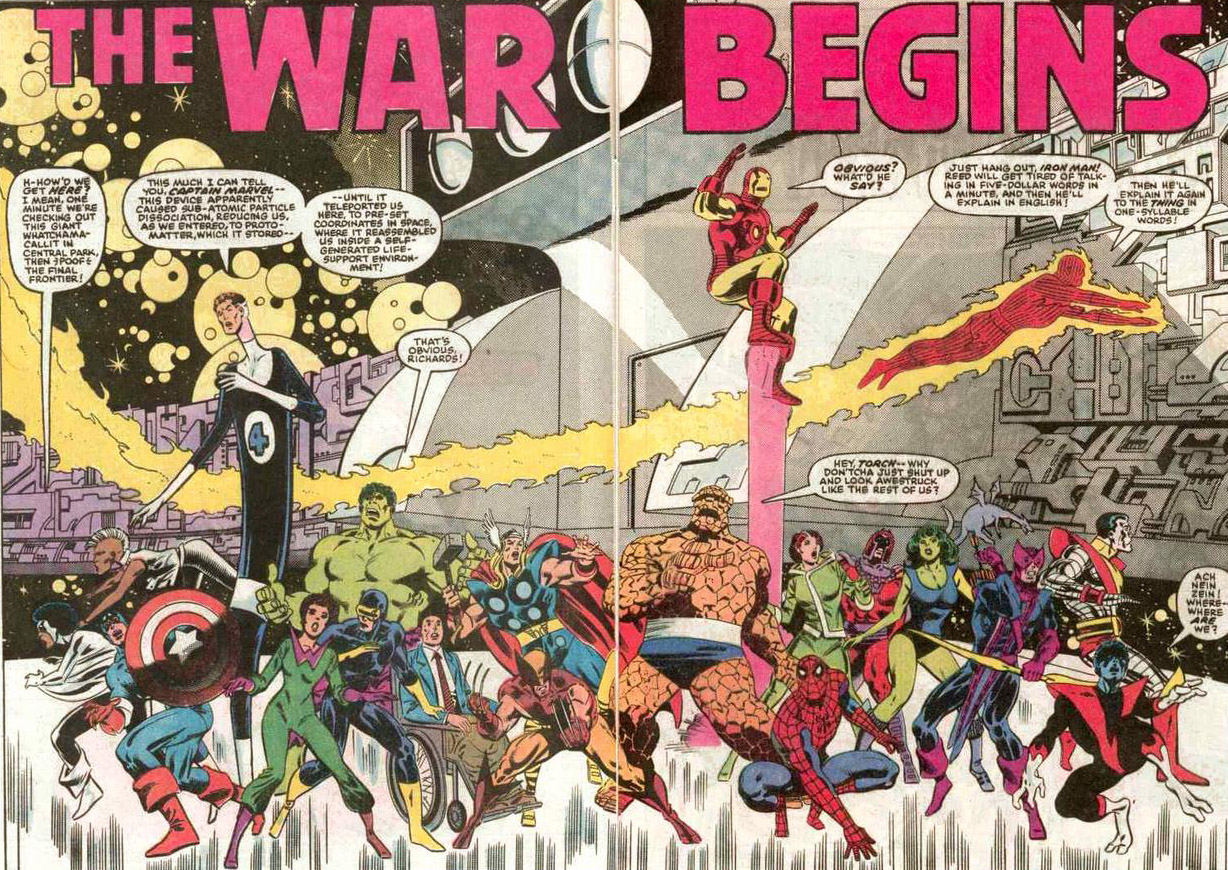
(Click the above image to maxi-size.)

I especially enjoyed the Thing's introduction of his team.

As they all watch, the galaxy around them is destroyed, and a planet is formed from chunks of planets from around the universe (we'll later learn that one chunk is from a suburb of Denver).


The participants are then told:
I am from Beyond! Slay your enemies and all you desire shall be yours! Nothing you dream of is impossible for me to accomplish!

They are then brought to the newly created planet and a series of battles take place.

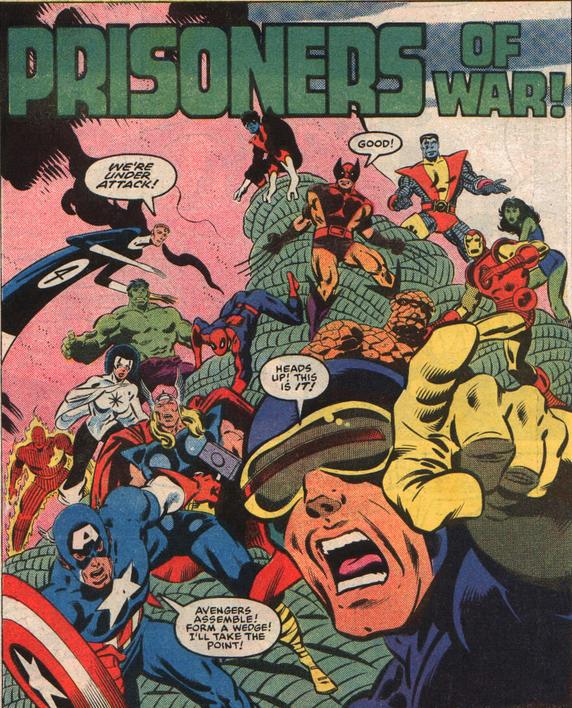
(I love Wolverine's "Good!" in that shot.)


Things heat up when Galactus summons his great worldship Taa II, leading everyone to wonder what he is up to.

Professor X and Magneto try to figure it out by reading Galactus' mind! It's a rare case where we see Magneto's little used mental powers.

But they push too hard and when Galactus notices them, he lashes out, nearly killing the X-Men. Their attempt also prevents Mr. Fantastic from talking to Galactus more conventionally, and causes him to send a robot to attack the non-mutant heroes.
Doom, however, sees an opportunity in Galactus' actions. He sends his villains to attack the heroes in order to draw Galactus' attention. The heroes are weak from having just fought off Galactus' robot, so it's up to the X-Men (shielded from Galactus' blast by Magneto) to save the day.

While Galactus is distracted, Doom beams up into his ship. As a delaying tactic, he has his villains try to create an instability in the planet, preventing Galactus from eating it right away. Xavier learns about the plot when he reads the villains' minds, but not the reasons why, since the Enchantress shuts him down.

So the X-Men are sent to stop the bad guys, and Wolverine seriously injures the Molecule Man in the process.


But after they drive the villains away, the X-Men decide to set off the instability anyway.
Eventually, however, Galactus does kick in and start eating the planet. It happens while the main group of heroes are off attacking Doom's villains, so it's up to the X-Men to hold him off.

It doesn't go well, and when the rest of the good guys show up, the X-Men are presumed killed (but are in fact just buried under a lot of rocks). It's worth noting that the Wasp, Captain Marvel, and Hawkeye are also in the area when the X-Men are seemingly killed, but they don't bother to try to help. Even later, when there's a break in the fight with Galactus (so that he can converse privately with Reed)...

....the main heroes head back to camp and don't try to help Colossus try to find his missing teammates.
This is when Reed comes back and tries to convince everyone not to fight Galactus. But later he changes his mind and helps with the attack.


But their efforts are irrelevant. Galactus goes forward and begins eating the planet anyway.

That's when Doom, who has already dissected Klaw in preparation...

...jumps in and steals Galactus' powers.

Having the powers of Galactus would be enough for any other mortal, but for Dr. Doom it's just a stepping stone to gaining the power of the Beyonder himself. And Doom succeeds.
The remaining two issues are really about Doom trying to contain his powers while the heroes decide whether or not to fight Doom or let him be. Doom claims that he's now above human concerns, but it's pointed out that one of his first acts is fixing his face.

He also intends to rescue his mother's soul from Mephisto's realm. After he's done with that, he intends to leave the mortal world, but in the meantime he's maintaining his human form and it's causing him some problems.
Another early act by Doom is to enlighten the Molecule Man.

With his new-found power expansion, the Molecule Man takes the remaining villains to the suburb of Denver and transports it home.

The act is too much for Dr. Octopus to accept, and he goes crazy. The Molecule Man immobilizes him and says that he's going to have him institutionalized when they get back to Earth.


This is actually making sure that Dr. Octopus will be institutionalized in Fantastic Four #267, which takes place soon after the FF get back from Secret Wars.
Back to the main plot, the heroes decide to fight Doom. Doom kills them all immediately, but he subconsciously brings them back. Klaw is possessed by a weakened Beyonder at this point, and when Captain America finally confronts Doom, he keeps bringing him back from the dead.


Eventually Doom is defeated, and he, Klaw, and the Beyonder all disappear.
It's a pretty complex plot for a toy advertisement! Much simpler to just have the good guys fight the bad guys and win and be done with it.
In the wrap-up, Mr. Fantastic figures out how to send everyone home. A stray dragon friend of Lockheed's screws up the X-Men's transport, which will lead to them re-appearing in Japan instead of Central Park along with everyone else. The Lizard's alter ego, Doc Connors, travels home with the unaffiliated heroes instead of the villains. And, of course, the Thing opts to remain behind.
New Characters
In addition to the characters that were initially brought to the Secret Wars planet by the Beyonder, we are introduced to a few new characters. First, there's Volcana and Titania, two new super-villains created by Dr. Doom (see below for more on that).
There's also Zsaji, a healer whose people were brought to the Secret Wars on one of the planet chunks that the Beyonder used to create the Battleplanet.

It's theorized that her healing ability also causes her patient to fall in love with her; a sort of reverse Florence Nightengale effect. The Human Torch has a little fling with her, but it's Colossus who really falls for her in a big way, causing him to doubt his already unstable feelings about Kitty Pryde. Zsaji eventually gives her life saving the heroes, so we'll never see her outside this series.
Also, there's Klaw. He's not a new character, of course, but he's here only incidentally. A while back Dazzler absorbed him and then shot him at Galactus, and he's been bouncing around the hull of Taa II as energy since then. While Doom's on the ship, he finds Klaw and revives him, but the experience has left Klaw mentally deficient.


He develops a friendship with the Lizard, on the grounds that they both talk funny.


Klaw mainly plays a King Lear's Fool role in this series; a foil to Dr. Doom.

Finally, there's a new Spider-Woman.

She's been an active super-hero in the suburb of Denver that got pulled to the Battleplanet. In her first fight in Secret Wars, she says that it's the fifth time she's been in a fight. In addition to Spider-Man style strength and speed, she also has the ability to generate psionic webbing.


The Wasp is out of the action for most of the series. She's captured by Magneto early on. He attempts to woo her but she doesn't fall for it. When the X-Men show up to join him, the Wasp attacks them all and then makes a break for it. She winds up in a swamp the Lizard has wandered off to after the first battle, and she's in the process of befriending him when the Wrecking Crew show up in a big vehicle to collect the Lizard, and seemingly kill her.

She's later revived by Zsaji, but she's effectively away from the hero team for more than half the series.
During the course of this story, the Thing reverts back and forth to Ben Grimm.

Eventually he learns to control it. Assuming it's related to the nature of the planet, he opts to stay behind when the other heroes finally leave. He asks She-Hulk to take his place in the Fantastic Four.

Another major change is Spidey's new costume. After the last major battle with the villains, most of the good guys are in need of new costumes. The Hulk locates a machine that creates new clothes (it's how the X-Men wind up with their bizarre John Romita Jr. outfits).

But Spidey goes to the wrong machine.


He winds up with a costume that generates its own webbing, responds to his thoughts, and looks a lot like the new Spider-Woman's outfit.


Mike Zeck's art never did a lot for me. He was a rising star from his work on Master of Kung Fu and Captain America prior to being chosen for this series, but his characters just don't have a lot of depth to me. Everyone looks a bit small and tapered.

On the other hand, he's a very good storyteller, and i imagine this series was quite demanding and speed was a factor. In fact, two issues of this series had to be drawn by Bob Layton (and aren't quite as good). So overall, the art isn't fantastic, but it it isn't bad.

Imagine if this series was drawn by John Byrne, though.
Aside from a run on the Punisher and the critically acclaimed Kraven's Last Hunt, Zeck didn't really do much more of note for Marvel. I read that Zeck nearly had a nervous breakdown working with Shooter. I don't know if that was meant figuratively or literally, but it may explain why he didn't do much else for Marvel.
Cool scenes:
Galactus eats Ultron:
In the very beginning, Ultron freaks out and starts trying to kill the other villains. Doom convinces a terrified Molecule Man to nudge Galactus into taking care of the situation.


Later, Doom will reprogram Ultron to act as a personal bodyguard.
Save perhaps Thor:
Just a quick moment, but when fighting the heroes in the beginning, Magneto makes a stray comment that he considers himself above all of the heroes, "save perhaps Thor". It's an honest acknowledgment of Thor's power levels, but i also like to think that Magneto is remembering his first encounter with Thor back in Journey Into Mystery #109.

Enchantress smash!
A very minor little scene, but i thought it was cool. During an early fight, the She-Hulk attacks the Enchantress, but the Enchantress is able to knock her away. She's normally not a physical fighter, but as an Asgardian Goddess, it makes sense that she'd be physically powerful.

Of course, this just lets She-Hulk know that she can unload on the Enchantress full-strength, which she does, causing considerable injury.
Spidey vs. the X-Men:
When Spider-Man hears that the X-Men are leaving the team to join Magneto, he goes to tattle to the others. The X-Men try to stop him, but they are unable to do so. Spidey is too fast and agile, and he manages to beat the whole team (look how he swats away Wolverine). Nice showing for a guy who, as the Human Torch says earlier, is used to fighting muggers.


Before Spidey can tattle, Professor Xavier wipes his mind, an action that causes him considerable guilt.
The Thunder God:
In issue #3, there's a huge worldwide storm, presumably due to the jigsaw way the world was put together. From a plotting perspective, it allows for some downtime and internal strife since no one can leave their bases. But it also provides a neat little moment for Thor, who protects the heroes' base from the storm but seems to enjoy being out in it a little too much.

Doom makes his own super-villains:
In that same storm, Doom uses the alien technology in his base to whip up some additional lackeys: Volcana and Titania. That's Dr. Doom for you. If he needs some super-villains, he just makes them. No problem. They aren't push-overs either; they are both shown to be devastatingly powerful. The subjects are two humans from the suburb of Denver that was included in the make-up of the Battleplanet. Both villains remained especially durable, with Titania in particular becoming a mainstay baddie of the Marvel Universe (usually partnered with the Absorbing Man).

It's also worth noting that while the good guys had a decent male-to-female mix, outside of the Enchantress, the villains were an all-males club, so it's nice to see their forces balanced out with some women. And not 'strike a pose and point' ladies, either. These are characters with physical powers. Finally, although the art doesn't do a great job of showing it, Volcana is meant to be an overweight woman, which is a rarity in comics.
Titania quickly earns the respect of her peers.


Molecule Man drops a mountain on the heroes:


Equally impressive, the Hulk holds up a mountain:
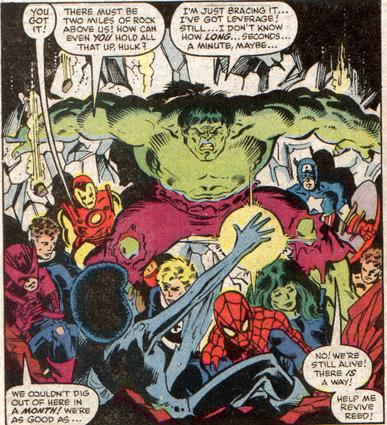
Mr. Fantastic deliberately keeps the Hulk angry so that he can maintain his strength.

Reed rigs a device using Spider-man's web-shooters to build a device that allows Iron Man to blast them out.

Then he apologizes to the Hulk, who at this point has figured out why Reed was rankling him.

Villain chat:
This is just a cool little scene where the Absorbing Man and Thunderball compare their weapons. I thought it was neat.

This scene also leads into one where Piledriver very stupidly goads Molecule Man for being a nerd and his newfound girlfriend Volcana for being fat. Considering they just saw the Molecule Man lift and drop a mountain by waving his hands, it's a dumb move, and it works out about as well as you would expect.
Doom rejects the Enchantress:
After failing to charm Thor, the Enchantress decides she wants off the Battleplanet. She tries to appeal to Dr. Doom, offering him her "love" and also a cure for his face. He's not interested. I guess i just really like Doom's cold silhouette in that second panel.

Rogue the Kree Warrior:
In issue #7, Rogue makes a reference to having "warrior skills".

I suspect that means the Kree training that she would have absorbed from Ms. Marvel along with her powers. It's not something that's mentioned very often. Neat little throwaway line.
Get off the can:
Just another minor character scene, but in issue #12 while the Enchantress is getting some information from a water sprite in Volcana's bathroom (the scene mainly serves as a recap), Absorbing Man bangs on the door, and i just find his line amusing.

On to some of the negatives...
First, as i mentioned above, the scripting isn't great. It's especially grating to hear Iron Man talk. Since it's James Rhodes in the suit, and James Rhodes is a black man, Shooter is always giving exclamations like "Sheeeoooot!", which is just awful.
Along those same lines, everyone's a bit melodramatic and moody. Half the characters are just completely mopey about being away from their wives and girlfriends and terrified that they'll never make it home again. It's a perfectly reasonable thing to be upset about. But the way it's written and the degree to which it is raised takes it from realistic to maudlin.
Now into some more fanboyish complaints. The Hulk is given short shrift throughout this series. While he's certainly the star of issue #4 where he holds up an entire mountain for the team, he's pretty ineffective in most of the fights. Sure, he's got Bruce Banner's brain in this series, and Mantlo had already established that he therefore doesn't have the savagery needed to get really angry, but he should still be pretty damn strong. Instead he's generally one of the first characters to get knocked out.


(Love that "Designed by trolls. For torture." line).


It's in this last scene with Ultron that the Hulk breaks his leg and winds up with a crutch that he carries for a few issues of Hulk post-Secret Wars.

Additionally, none of the villains in this series come from his rogues gallery (except, arguably, the Absorbing Man, but he first appeared in Thor and has been an Avengers foe as much as the Hulk). The same is actually true of the X-Men as well, since Magneto winds up being an ally.
In general, there isn't much by way of grudge matches, or any real acknowledgment that some of these heroes and villains have special histories with each other. Dr. Octopus never freaks out about Spider-Man, for example. It's probably for the best as scenes like that could wind up being pretty bad, but if done well it could have added a little more personality to some characters. Similarly, there aren't any really cool scenes where, say, the X-Men go up against the Absorbing Man and realize what a powerhouse he is. The fights aren't badly written but they don't have the right sense of uniqueness. Although it is cool when Wolverine slices of Absorbing Man's arm and he has to find out if he can reattach it.


Some continuity errors from the first issue are subsequently covered for in the dialogue of later issues. First, Dr. Doom should be dead at this point. Unlike previous deaths, John Byrne intended this to be a definitive 'Dr. Doom is really dead this time' plot that would set the ground for a dramatic return in a later issue of FF. Having him appear here is incongruous, but on the other hand of course the premiere villain of the Marvel Universe was going to appear in this series. We'll learn much later that Doom was actually plucked from time so that the Beyonder could include him in this contest. On a smaller scale, Cyclops was not a member of the X-Men at the time they went into the Secret Wars construct, so it's later said that he was plucked away from his honeymoon. Similarly, Lockheed the dragon wasn't shown to be with the X-Men ether, but he's here as well. No explanation for him. This makes Cyclops (and possibly Lockheed, unless he was in Colossus's jacket the whole time in Uncanny X-Men #180) the only hero to have been forceably brought to Secret Wars, as opposed to lured into the construct in Central Park. However, presumably all of the villains were brought this way, so it's not that unusual (The Beyonder provides some more information on how everyone was brought to the Battleplanet in Secret Wars II #3). Finally, Xavier is in a wheelchair in issue #1 even though he wasn't in X-Men #180. It's stated that the Beyonder must have corrected all the little things that seemed 'wrong' to him.
All in all, a fun epic. Not a groundbreaking work of art, but definitely a great crossover.
A few housekeeping notes: First, since Spider-Man's costume is itself a living entity, i need to track it as a character. But it's not accurate to call it Venom until it is bonded with Eddie Brock. So we'll be calling it Venom Symbiote as long as it's not connected to Brock.
Second, regarding the Historical Significance Rating. The way Secret Wars was published, a lot of the effects of the series were known in the main on-going books before we saw why it occurred in Secret Wars. So Spider-Man's new costume was first seen in Amazing Spider-Man #252, She-Hulk appeared as a member of the FF in Fantastic Four #265, etc. And then later we see in Secret Wars how Spidey found the costume, and why the Thing asked She-Hulk to replace him, and so on. For the sake of awarding Historical Significance Rating points, i'm giving a lot of credit to Secret Wars since this series was the driving factor that caused those events to occur. But i'll also give some points to the issues where those changes were first published. To be honest, and this may come as a bit of a shock to my loyal readers, these points don't actually cost me anything and i can afford to be generous with them.
Third, there's a brief scene where Galactus allows Mr. Fantastic to view Sue and Franklin at home on Earth. It's meant to be a real-time viewing, and that's enough for me to count it as character appearances (although the MCP doesn't).
Quality Rating: B
Historical Significance Rating: 8 - First Beyonder. First Titania, Volcana, and Spider-Woman II. First appearance of Spider-Man's symbiote costume. Thing quits the Fantastic Four and gets a new status quo. She-Hulk joins the Fantastic Four. Molecule Man gets a major power upgrade. Iron Man gets an updated suit of armor. Developments in the relationship between Magneto and the X-Men. Major impact on Colossus' relationship with Kitty Pryde. Hulk breaks a leg. First line-wide crossover.
Chronological Placement Considerations: Rather than me list where every character here fits into their surrounding issues, just see the surrounding respective entries. See above for some notes on Dr. Doom's appearance here; he's basically been plucked out of time and he actually appears here during Fantastic Four #288 (Mar 86 cover date).
References:
- Magneto's most heinous crime was the sinking of a Russian submarine in Uncanny X-Men #150. This is one of the few actual footnotes in this series.
- The Molecule Man mentions that he's been seeing a therapist since the Avengers convinced him not to destroy the earth in Avengers #216. No footnote.
- Mr. Fantastic saved Galactus' life in Fantastic Four #244. Another rare footnoted reference.
- Klaw was absorbed by Dazzler and subsequently fired at Galactus in Dazzler #9-10. No footnote, but there is a four panel recap of those scenes.
Crossover: N/A
Continuity Insert? N
My Reprint: N/A
Inbound References (105): showCharacters Appearing: Absorbing Man, Beyonder, Bulldozer, Captain America, Captain Marvel (Monica Rambeau), Colossus, Cyclops, Doctor Octopus, Dr. Doom, Enchantress, Franklin Richards, Galactus, Hawkeye, Hulk, Human Torch, Invisible Woman, Kang, Klaw, Lizard, Lockheed, Magneto, Molecule Man, Mr. Fantastic, Nightcrawler, Omnivore, Piledriver, Professor X, Puff, Rogue, She-Hulk, Spider-Man, Spider-Woman (Julia Carpenter), Storm, Thing, Thor, Thunderball, Titania, Ultron, Venom Symbiote, Volcana, War Machine, Wasp, Wolverine, Wrecker, Zsaji Previous:
New Mutants #15-17Up:
MainNext:
ROM #53
Comments
i love this series. it is much more than just a slugfest. it has some of my favourite scenes in comics: spider-man trashing the x-men and later his epic defeat of Titania (who was a real badass and undefeated up to that point), dr doom vs galactus, every line by the absorbing man, it establishes cap as THE premiere leader of heroes (as well as respect from dr doom "of all the heroes, Captain, you of course would make it this far.") the final scene of dr doom phasing cap in and out of existance and ultimately cap still trying to save him.
great comic fun.
plus spidey kicking wolverines butt easily.
While I agree this is the better comic, DC's Super Powers mini was written by Kirby and is, therefore, awesome.
The clunkiness in Shooter's dialogue stems from his experience under Superman books editor Mort Weisinger from 1966-69. Mort's Superman titles were very densely plotted and relied almost entirely on dialogue for exposition and moving the plot along, very much in "tell, don't show" mode. Shooter never quite reached the level of dialogue-as-plot-mover during his time as Marvel EIC, but in series like this one he came very close(and contemporary comic critics didn't like it one bit--they tended to find it juvenile and completely unsubtle).
Good reflections, although as many other you gave to much credit to Doom.
I see far worthy Magnetos attitude that Dooms and my conclusions does not only includes this issue but to all the profile of the characters over their life.
You see a undying will of Doom. I see the core disease of Doom who he is slave,captive of his hunger for power the same as Galactus for living. He saw Beyonder as his answer to his dreams or objectives the same way he try previously with Silver Surfer until Galactus remind him his position.
How Magneto acted here his actions make coherence with his way of thinking over time.
I see a man who try to shape the world as he sees fit for his kind although by whatever means necessary. He dont try to steal power maybe because he has the power he need in fact he is intelligent enough to create divecis that grant power to humans and devices that nullify mutant power except his own, I think Magneto knows that to achive goals you need to change the poeple mutans-metahumans the enviroment around you not to use one blast to reshape everything in one shot. This is a more mature mind.
Magneto allowed, He accept to play the game and dontknow if it was for curiosity or to settle a challenge.
and Beyonder dont put Mags with the heroes not just because he want it to be that way but because he does not see Magneto share what all villains have in common, you now Stan Lee said it: I dont see Magneto as a bad guy. He redefined hero and villains to antihero.
But Magneto also has courage and pride and did not accept submission to Doom rather he accept co-work some sort as equals with Doom realizing they have better chances in team that face it alone, Doom comprehend this too otherwise he havent bother to ask in his own peculiar way Mags help and also to see if he was going to cooperate with heroes and oppose him threat.
What! No mention of the awesomest piece of dialogue ever?! When baddies are bringing clawed Molecule Man home and Volcana asks Doc Ock can't you do something, you're a doctor and Ock replies "I'm a doctor of nuclear physics, not a MD." There is no topping that.
About Magneto and Thor, I think there's Mag's mutant supremacism talking. Thor as a god might be on par with him, but certainly none of the rest flatscan sapiens are.
Early news on this book from Comics Journal#85 is interesting. It was announced as "The Secret War" and developed as "Cosmic Champions". The toy line seemed to be based on the book, rather than the other way around. Spider-Man's new costume had red where the white would later be. The first 3 issues were supposed to be set-up and everyone would go to Warworld in #4. Roger Stern and John Byrne were credited for providing ideas. A cartoon and video game were proposed. The official statement from Marvel was that all issues occurred between main books dated 12/83 and 1/84, and that Rom #53 was an SW tie-in crossing over with all other Marvel Universe books(though it wasn't specified if the other book spillover was intended to take place sequentially or simultaneously).
Amazing Heroes #59 has an interesting interview with Zeck. He explains the deficiencies in his art due to the fact that the toy contract required a specific deadline for each issue, and that Zeck would always get the scripts on short notice. The first script was so late that he had to do it in the middle of a Defenders fill-in, and he described #1 as having him on only layouts while Beatty finished it. Zeck also mentioned lots of redrawing; for example, Kitty Pryde was also supposed to be in #1 and was drawn there, but the X-Editors didn't have her go to Warworld, so all her figures had to be redrawn(Zeck said the same thing almost happened to Cyclops). Bob Layton was requested to give Zeck some breathing room, and Shooter started including his own layouts with the scripts halfway through.
Zeck also stated there was a finished Sandman solo story be DeFalco/Zeck/Dan Green intended for a proposed "Marvel Double Feature" book co-starring Vision & Scarlet Witch by Mantlo/Mignola. I have no idea if it ever got published.
An Amazing Heroes review of the last issue claimed that it was the work of multiple inkers, and cited John Byrne and Joe Rubinstein in particular.
Secret Wars was published in Marvel UK and my goodness I loved it. I was a kid but it really captured my imagination at the time. I can't understand why everyone hated it. Maybe they were older than who it was intended for. To me the view that it was bad comes across a bit elitist.
I will admit that even as a kid I did find SW2 pretty dull.
One of my favorite moments is in issue #3 when Doom, via Ultron, kills Kang, and Kang screams "You'll need me later, you fool. Don't...!" Later, when Doom reintegrates Kang in issue #12 I believe, Kang's still in mid sentence saying "..You realize how essential Kang is...to..your...plans."
"Unlike previous deaths, John Byrne intended this to be a definitive 'Dr. Doom is really dead this time' plot that would set the ground for a dramatic return in a later issue of FF."
LOL..."Really dead this time" although he was shown to switch bodies and diss Aunt May after he was stuck in his armor in FF.
I really wanted to like this series more. And while the idea and story line are very good, I agree with you that the dialogue is clunky. The art itself ranged from pretty good/not bad to terrible depending on the panels I was viewing. For example, a lot of the heroes in far off scenes looked very stick man-like. I dislike Doom's face with the smaller features and small mouth. Spider-man's eyes are positioned wrong in the above panels.
As for the story/dialogue I hated that Claw was turned into a blabbering idiot. I collected a few of these, read them a few times, and then sold them off within a couple years later. Did a search for this to see your take on it. Still don't like the art, but then again I somewhat unfairly expect every Marvel artist to be almost as awesome as John Buscema.
This was my first taste of Marvel comics, specifically Secret Wars UK #17 (October 1985), which was part of the US's issue #8.
The UK version (mostly weekly) was in 31 parts and, like jsfan, I loved it, though I was probably younger than the usual fan, too - though it inspired me to try to find older comics, and with Magneto as (anti-) hero, Cap's shield broken, Jim Rhodes as Iron Man, handsome Doom without his mask, etc... it was quite an unusual time to get into Marvel!
Volcana overweight? I suppose from the woefully outdated BMI chart. More like curvey to me.
I kinda felt sorry for magneto. He helped the heroes save the universe, but the avengers humiliated him for years afterward. This is where captain america lost his honor.
1 - Being roughly the same age as you, the toyline was a big thing for me. I was just slightly too young for Megos and now suddenly there were superhero figures - I no longer had to have my Star Wars figures double up as superheroes! My first one was Captain America. I loved it - even took it to camp with me. In 2007 when I sold my comic collection, and most of my comic related toys, I kept Cap. The paint on his stripes, the end of his gloves and his nose has rubbed off, but I still have him after 30 years.
2 - I still have a poster for the series, even though, ironically, I never owned the series itself (my brother had it, so I never needed it). The poster, of course, has Kitty Pryde, even though she wouldn't end up in the series (the poster is basically the cover to issue #1 but Kitty was on the far left, next to Cyclops).
3 - As you say, the placement of Magneto in the hero satellite is really Shooter backing up Claremont on the redemption of Magneto. But it does make you wonder why Galactus, who doesn't seem to be evil (certainly not on a cosmic scale, given the result of Reed's trial) is placed in the villain side.
4 - "Dissturb our gamess-s and the Lizard will destroy you! Once we finissh, we will do as you s-ssay!" A classic line. One of my favorite moments in the whole series.
5 - Spider-Man taking out the X-Men. This was recently featured on Comics Should Be Good under their series of the wrong person won the fight, a series I highly disagree with, and especially in this case. Spider-Man has tremendous speed and agility and a whole lot of experience. He is truly an amazing hero and we don't often get the full measure of that. I am a lifelong fan of the X-Men, but this just really shows how incredible Spider-Man really is and I find it totally believable. A fantastic moment.
6 - Really, some kudos go to Marvel for designing this whole thing but having to know in advance what changes would occur, because all of them had to kick in the next month in the regular books even though some of them wouldn't appear in this series for almost a year. On the other hand, that did mean that we knew a lot of things that had to happen by the end of the series.
7 - For those who weren't around at the time, it's hard to describe just how big a deal it was that Spider-Man got a new costume and how much hype it got.
8 - It was interesting who was not included. Dr. Strange seemed an odd omission. Sub-Mariner could have made the series interesting. Also, none of the Defenders appear. They could have perhaps included Power Man and Iron Fist. But Daredevil is clearly the big one - even though he would seem at odds with this cosmic story, he is the only Marvel character who has had his own title running continuously since the early days of Marvel not to appear in this series. They seemed to have tried to make up for that by including him in the later line of Secret Wars figures (yeah, I had that figure too).
9 - One last word about the art. I think the art is the real weak spot of the series and nothing spotlights that more than #4. In the issue itself, it always just looked like the characters were sitting in a cave. We see the Hulk straining, but we don't really get the sense of danger. Now, look at the cover, on the other hand. In my opinion, it's one of the great covers of all-time. It really makes you realize that the Hulk is holding up a friggin mountain range! I always bring this up when explaining how strong the Hulk is - there is no limit to his strength. He held up a mountain range!
If I remember, the X-Men had just said goodbye to Kitty, so yeah, Lockheed was probably hiding with them.
One thing that bothers me about this series is that the villains really don't have a chance. If we don't count the X-Men, Magneto or Galactus, there's 12 heroes against 12 villains. The FF and Avengers have plenty of experience as a team, and working with each other, and working with Spider-Man. Moreover, they have a much wider range of powers.
Granted there are exceptions like Ultron, the Enchantress and the Molecule Man, but most of the villains' power is pretty much based on strength. Sure, Doc Ock has his arms, but if they couldn't lift cars and stuff, he'd be worthless. The Absorbing Man is a powerhouse, but what does he usually do? Absorb something with strength and toughness. Iron Man, Spider-Man, Thor and Rogue all have superstrength and multiple other powers besides. Hulk, Shulky, Colossus and the Thing could probably wipe out most of the villains themselves.
Letting Galactus win really would have been the smartest ploy. Reed could have figured out a way for the heroes to save themselves and the suburb of Denver (and Zsaji's people) while Galactus chows down, problem solved.
I recently picked up the Secret Wars omnibus. It has Zeck's original pencils for issue 1 in the back, and they're heart-breaking to see. I'm not a big Zeck fan, but he could do beautiful work when he tried, and he was really giving it his all here. There's a detail and 3-dimensionality to the figures that's destroyed by the slap-dash inking and flat, uninspired coloring. And of course there are entire pages Shooter forced him to redraw for some silly editorial reason, which clearly destroyed his morale. I think this series would have been a mess regardless because of Shooter's writing, but it could have been so much better if Shooter had understood the value art as art, instead of simply an extension of the writing.
@ChrisW- the problem with letting Galactus win is what if there were other people on Battleworld that the heroes were unaware of? Or someone from Denver or Zsaji's village had wandered away?
I'm not saying it's a perfect solution, but (a) with all that nifty technology in their fortress, they'd have had a good chance for success and (b) Reed was willing to let them all die when he first had the idea to let Galactus win anyway.
I just realized something; did the series ever show what happened to Galactus after Doom stole his meal?
Doom says later in the series that he used his Beyonder powers to make sure that Nova found him where he was floating in space.
Ah. It's been a few years since I read the series; recently I just picked up the audiobook. Yes, there's an audiobook. You might like it, fnord. It adapts the series pretty damn closely. It even has Lockheed!
Just wanted to add to Mark Drummond's notifications:
The panel above the Enchantress blowing off Xavier is Butch Guice; in #12, I see evidence of Al Milgrom, Art Adams and Armando Gil. Possibly more...I'll get back if I can conclusively prove more.
Seeing the cover of issue 4 in the local newsagent as an 11 year old is what got me into comics. Magic.
Cool missed villain side choice opportunities, round one. Go!
Juggernaut
Moonstone
The Shroud
Sandman
Rhino
The Leader
Abomination
Zarathos
U Foes
Dormammu
And Task Master.
Bullseye
Plus:
A section of Brood World
and maybe the Blue Area of the Moon? (Maybe not so Secret?)
And too bad he didn't snatch Jotunheim.
We are talking about a comic only George Perez would take on!
But what do you think of some of these?
Forgot Living Laser. Wizard. Speed Demon, on a battlefield, could be trouble. I want to say Radioactive Man.
A Foolkiller staying in that Denver suburb would have also been cool.
Just happen to agree the initial villain threat could be more credible. Know we've got a lot of bruisers here, but even Mr. Hyde!
A piece of counter Earth? Idk, I thought the patchwork Battle World could have been wilder, more character of its own. Very cool stuff though!!
Conversely, the Beyonder could have picked only Silver Age Ant Man and Daredevil foes! Led of course by Paste Pot Pie...I mean the Trapster and Mindworm.
An issue ten appearance of a cavalry of Dr. Strange, Silver Surfer and even Namor and Loki (!) would also be cool.
More trickery and personal stakes in place of the cookie cutter maudlin bits. And much more philosophy on the fly, even from James Rhodes, in place of Shee-oot! Imagine an ounce of verbal gold in place of redundancy and stilted lines.
Yes.
I don't think you really should go hog wild with the heroes and villains on Battleworld in Secret Wars; you really just need a cross-section of the universe in general in order to get it right while having enough space to introduce new characters that will have somewhat of an impact on the universe (Beyonder, Titania, Spider Woman II) or develop those that take a unique turn within this to make it all the more believable (obviously Doom and the Molecule Man among others) If you flood it with anybody and anything, then it becomes Secret Wars II.
Looking over the characters that were chosen, it is a rather good cross-section of the universe at the time, with elements of the major teams (Avengers, X-Men, F4) and the most well known of the solo heroes (Hulk, Spidey); while the villain side has quite a few powerhouses (Asgardian empowered such as the Wrecking Crew, Absorbing Man and Enchantress, obvious major players like Doom, Magneto, Ultron and Galactus, and a few notable but powerful ones like Doc Ock or Klaw) It would have been neat to have another street level hero of some sort on the heroes side that would have allowed for a unique interpretation outside what we'd have with Spidey (someone like Daredevil or Luke Cage); while among villains, the only one that probably stands out that would have been neat is either Taskmaster or the Leader.
BTW: they're saying now the Deadpool Secret Wars crossover is continuity...is that true or not? (and would it have to be added in sooner rather than later)
Issue 10 (DOOM vs BEYONDER) was my first SW comic and I was 7 years old. My life was never the same after that.
I can't believe Peter Parker is Dr. Doom all along. :P
What the heck is with all the spoilers for another story here, JC?
Yeah, i've deleted JC's comment. I assume he was trying to be "funny", but please keep conversations about current comics to the forum.
I'm finally making my way through Secret Wars through trade, and admittedly I actually like some of Layton's work more than Zeck's, particularly with the females. His versions of Volcana, Titania and Shulkie are way more attractive than the versions that Zeck throws; particularly those weird faces he keeps giving Jen somehow or another. The pics Layton gives of Volcana are just gorgeous and really makes me see how Molecule Man ended up with a winner.
Having read fnord's in-depth, insightful analysis of the original Secret Wars, now I really want to re-read it, see how I feel about it all these years later.
I finally finished Secret Wars, and it really is as epic and great as advertised. The interesting thing about the series is just how it works both as an individual story that is self-contained while at the same time playing on all of the elements of the Marvel Universe and the history of the 25+ years of continuity that had been going on up to this point. You don't need to know anything about these characters to enjoy it, but knowing of their circumstances makes it all the more enjoyable. A few of my own personal thoughts on this:
-There is a great balance of the dealings between the mundane and the spectacular of this universe from the characters that are involved. One of my favorite moments of this story is Spider-Man just admitting that he's way in over his head with all that goes on here but still dealing with things regardless. I also really like just the friendship of Galactus and Reed Richards and how in a way Reed is conflicted between letting the cosmic being win against the Beyonder's scheme or standing up to him to help protect his allies.
-Obviously Doctor Doom is a highlight of the story but what makes him interesting is that he does admit to his own human problems even as he aspire for greater ambitions. He ultimately fails in an early attempt to steal Galactus' power and just decides to move on; while the concept of him trying to make peace with the heroes while still doing vain things like trying to save his mother from Mephisto or fixing his face really shows that he isn't as noble as he claims. It is interesting that he did offer the heroes a chance to leave but they didn't take it because Doom is so unpredictable, leading to the hilarious "bolt from the blue killing everyone" cliffhanger; and while I knew it would be undone and the way it was done is utterly ridiculous, I did like that it was Doom's own paranoia of needing to prove himself to someone that really sparked his own downfall.
-Aside from Doom, there were quite a few other characters that did stand out in a good way: Reed and Cap obviously for what they did, but also Xavier as sort of this "wild card" character due to just how detached the X-Men had become due to Claremont despite still being in the same universe. Monica and Shulkie also impressed me; I loved Jen's battle with Amora early on and really while what she did regarding vengeance for Jan is questionable, she made a great stand until they all ganged up on her. Bruce's epic "holding up a mountain" moment was great, and Spidey was Spidey, even after he got his new costume that someday is going to have an obsessive desire to eat his brain...then again, no one realized that yet. On the villain side aside Doom, I liked the Enchantress and the Wrecking Crew. (which is weird in that they're all Thor-related but Thor was just...not as important as you'd think, especially with this coming in the midst of the Simonson run with the Malkith and Surtur elements building) I just liked Amora just being more a selfish villainess willing to use her female wiles and who is not as interested in the Beyonder's game and just wants out.
-It's tough to say any of the new characters won me over with anything seen here. Volcana just felt like she was there to give someone for the Molecule Man to relay off of, and somehow I've seen Titania in better situations; let alone you don't' get enough of Jessica Drew. Likewise, I wasn't a fan of the whole "Zsaji" storyline and it didn't work to the advantage of Pieter in particular. Also sort of just felt Molecule Man himself was just there due to Shooter just continuing what he started with him with his Avengers run, and obviously Klaw was just sort of an annoying plot device. I'm a bit torn on Rhodey being there though: I did like it was him and not Tony as Iron Man but I think they were overplaying his "I'm the only black man in a world like this" bit at times.
-And then there's the Beyonder...I sort of do like the playful nature of him as a cosmic being here who uses this "war" to study those involved and who screws over Doom at the end; if this was his only story, then it would have been fine...except of course then came Secret Wars II...
-
When I finally bought Sean Howe's "Marvel Comics, The Untold Story" that I'd seen so many good reviews for, I flicked open the book at a random page, which happened to be the page about Secret Wars. Howe claims that "Claremont had taken great pains to transform Magneto into a compelling, possibly noble Auschwitz survivor who'd made peace with the X-Men; in Secret Wars, he was once again reduced to a violent ideologue who would slay all who stood in the way of his dream of peace. The bad guys were all either thugs or megalomaniacs, with one exception. The Molecule Man was clearly the character that most fascinated Shooter."
I don't disagree that the Molecule Man was one of the characters Shooter liked best, but to anyone who hasn't read this series, Howe seems to be claiming that the Magneto of this series is merely one of the "thugs or megalomaniacs" bad guys given no shading, which I find a complete misrepresentation of how Magneto is treated here. There's no mention of Magneto actually arriving with the "good guys", or that he spends much of the series teamed up with either the X-Men or the heroes as a whole. I enjoyed Howe's book, but the page I opened with couldn't have given me a worse impression of how factually accurate the rest of the book might be. (To be honest I'm not sure how accurate it all is, there does seem to be plenty of unproven gossip or anecdotes presented as fact, but it's a good read.)
In fact, while we'd had X-Men 150 and God Loves, Man Kills both showing some backstory of Magneto and the start of some co-operation with the X-Men, I wouldn't say any definitive "peace" had yet been established, to me it was more "we won't fight on this particular occasion", and that most of the peace between Magneto and X-Men Howe seems to be referring to actually took place during and after Secret Wars, not before. (Not that it probably wasn't all Claremont's idea, just that it hadn't really seen print yet.)
Speaking of the X-Men and Secret Wars, has anyone ever confirmed what the deal was with Colossus falling in love with Zsaji and dumping Kitty? I seem to remember some gossip (not in Howe's book this time) that it had been done because editorial were unhappy about Colossus seeming to have a relationship with an underage girl, though Claremont had already had Colossus saying nothing would happen because she was too young. So was it Claremont's idea to split them up to set up some drama, or was it done by editorial/Shooter against Claremont's will?
I think it's firmly established that Shooter was against Kitty and Peter's relationship due to her age, and decided to use Secret Wars to break them up, against Claremont's wishes. I've always found the decision weird, because Claremont had repeatedly mentioned that Colossus is a teenager too. So if at the start of their relationship Kitty was 14 and Peter was 16 or 17, that's sounds like an acceptable age difference in a teen relationship (especially since there were no hints of the two consumating it), not something that should be controversial. Perhaps the problem was that, due to his physical size, Colossus doesn't look like a teenager, so to the casual reader his romance with the more obviously teen-looking Kitty might've seemed dodgy.
And Howe definitely seems to have confused Magneto's chronology. Unless I totally misremember it, at the time Secret Wars came out Magneto's reformation was still a fresh development, and Shooter having the Beyonder place him in the heroes camp was him helping Claremont to sell Magneto as a hero, certainly not hindering Claremont's attempt to reform him.
Don't have the comics to hand but in my memory I think Kitty joined aged 13 (and a half?) and I seem to remember Colossus being about 19, though like you say the fact that he's basically a giant stack of fully grown muscle even in human form makes it hard to read him as being 19. I think there was some mention in either the comics or a handbook that he was very strong but was only young & would become even stronger when fully grown, but I can't see there was much growing left to do... (Come to think of it, on some rare occasions Claremont would treat him as being immature, maybe chiefly in his breakup with Kitty, but generally he was a pretty sensible adult. If he did join aged 19 he would only be a year or two older than the oldest New Mutants, and I don't remember him being portrayed that way.)
Totally agree with you on Magneto's reformation, seems to me that Shooter was exactly continuing what Claremont had started.
I think your first sentence about Shooter being against Kitty & Piotr was what I'd heard too, I was just wondering if either Claremont or Shooter had directly commented on it (and if they hadn't, who the source was).
It's interesting, I've read the story that "Shooter wanted to break up Peter and Kitty because of her age" a million times; you can see it repeated here, here, here, here and here, for example... But I don't think I've ever come across any first-hand comment by either Shooter or Claremont about the reasons for the breakup. (IIRC Howe doesn't mention the breakup in his book when discussing Secret Wars.)
(I posted links to several articles repeating the "Shooter wanted to see Colossus and Kitty separate because of her age", but the site seems to think the post is spam, so it needs Fnord's approval before it appears here. Anyway, my point was that no one of them have any direct quotes on Shooter or Claremont on the subject, and I'm not sure if I've ever seen either of them comment on it directly. It seems to just be a bit of received wisdom among the fandom.)
I guess it's possible people have always simply assumed (without any first-hand evidence) Shooter wanted to break up Peter and Kitty, because how else would you explain what happens to him in SW? It's pretty weird that a fairly important subplot Claremont had been building for quite some time is abruptly resolved in a different book (one that doesn't really focus on the X-Men at all) by a different writer, using a character who's main function in the story is to facilitate the breakup. It seems pretty obvious Shooter was keen on separating them up, because the Colossus/Zsaji romance serves no other function in the story. If he just wanted to include Zsaji's tragic sacrifice to SW, he could've simply had Zsaji stay in a relationship with Johnny Storm and have him to be the one that she dies to save.
Also, I think Howe is wrong in saying that the Molecule Man is the only interesting villain in SW, because what Shooter does with Doom is certainly the high point of the entire series. To me, the usage of Doom is what lifts Secret Wars above the similarly themed Korvac Saga, which some people seem to rate higher than SW. In that story, Korvac is pretty much an unknown quantity; neither the heroes nor the readers know what really motivates him to do what he does until the very end of the plotline, where we're all of a sudden expected to accept that Korvac was right and the "good" guys were wrong. Korvac is pretty much just a plot device Shooter uses to get to the moral he wanted the story to have.
Compared to that, Doom's omnipotence in SW is much more complex and interesting. First of all, we see him steal the powers of Beyonder through sheer determination and intelligence, which definitely makes him root for him, being the ultimate underdog. And Doom (unlike Korvac) has had a long character history before this story, so we know there's a noble side to him, that in his own mind he's a just and righteous ruler. Because of that, it's easy for us to accept he genuinely believes his omnipotence would be benevolent, that he could use it to make the universe better, even if that belief may be misguided. That makes the way he deals with his godhood, and the way the heroes come to the difficult decision of opposing him way more interesting morally than the preachiness of the KS.
Well I can't see your earlier comment yet, but I'll reply now and hope I don't look stupid when Fnord approves it and it suddenly appears :)
I don't really have an opinion either way whether it was Shooter's idea or Claremont's, they both seem possible to me. I was just wondering if anyone did know. Or maybe Shooter had been pressuring Claremont to do something about it and so Claremont decided to split them up which would resolve the age issue for now, and he could always get them back together later as the future predicted.
My thinking (and I could be totally wrong) is that Shooter said to all the writers/editors of the major books that there should be some change in their book caused by Secret Wars, so the readers of those books would feel they had to read SW to find out about the changes (almost all of which happened in the last issue, but by then they'd already bought the series). Shooter was involved in the change in Spidey's costume, but Byrne came up with the idea for Thing to leave and be replaced by the She-Hulk, so maybe Mantlo came up with the idea for Hulk to injure his leg and maybe Claremont came up with the idea that Piotr and Kitty split up. It makes sense to me that if you ask Claremont for a plot point, he would think of something emotional. And Claremont still got to do the actual breakup in a classic scene (and classic issue as a whole) in his own book, it didn't really matter that someone else did the set-up.
In his book, Howe also makes a direct comparison between Shooter's editorial position and his depiction of omnipotence in the Korvac saga, how he seems to be saying, "trust the authority". But I think it's interesting to compare the Korvac Saga and SW in this regard... The former was written when Shooter wasn't yet Editor-In-Chief, and it certainly depicts Korvac's acquired godhood as good thing. But SW, written when Shooter had become EIC and was at the height of his powers, is far more ambiguous about Doom's omnipotence. We never know for sure whether the heroes were right or wrong in attacking him, though there certainly are hints that having such power is more than one man can handle. So Shooter's relation to ultimate power and authority, or at least the way he writes about it, is not as straightforward as Howe wants to present it.
My thinking (and I could be totally wrong) is that Shooter said to all the writers/editors of the major books that there should be some change in their book caused by Secret Wars, so the readers of those books would feel they had to read SW to find out about the changes (almost all of which happened in the last issue, but by then they'd already bought the series). Shooter was involved in the change in Spidey's costume, but Byrne came up with the idea for Thing to leave and be replaced by the She-Hulk, so maybe Mantlo came up with the idea for Hulk to injure his leg and maybe Claremont came up with the idea that Piotr and Kitty split up.
You could be right about this, but I think it's worth nothing that all the other major changes done by Secret Wars (Spidey's black suit, new Spider-Woman, She-Hulk joining the FF, etc) were cases were SW introduced new concepts to other books, new ideas the writers of those books could build on. Whereas the Peter/Zsaji romance is the only example where Shooter's plot radically affects an already established plotline, one that had been going on in UXM for a couple of years. That's why it feels like less of a case of "let's come up with new story ideas!" rather than "let's end a subplot that's become unacceptable".
Yeah I think sometimes in the book Howe has an argument he wants to make and he ignores some things that don't fit into his thesis. I think the villains are generally portrayed as they had been in the past (except Klaw and Ultron, but there are reasons for those), it's not as if Absorbing Man and the Wrecking Crew had ever been anything but thugs, and people like Dr Octopus and Volcana aren't either thugs or megalomaniacs. And there's several dozen characters to deal with, it's not as if it's common for big crossover events to feature a lot of character development of villains. (Frankly I'd say Shooter did a lot more character work than most crossovers manage.)
Agreed also that Doom in Secret Wars (and in Byrne's FF at the time) is one of the great portrayals of Doom. It is hard reading Doom in a lot of other comics when you've seen him be portrayed so efficiently here.
One thing I've just remembered is the fact that Kitty was originally intended to be in Secret Wars (she's on the promo artwork) and then at the last minute wasn't. Whether that's because they just forgot to draw Kitty entering the Beyonder's structure, or that Claremont had the abduction of Kitty story planned for New Mutants 16-17, or that Shooter/Claremont decided to have Kitty not be there so they could split up her & Colossus, again I'm not sure either Shooter or Claremont has confirmed that.
"Shooter's relation to ultimate power and authority, or at least the way he writes about it, is not as straightforward as Howe wants to present it."
Yeah it's clear that great power is a running theme in Shooter's comics, but as well as Korvac, Doom and the Beyonder, you've also got Moondragon taking over an entire planet in Avengers & the Molecule Man being fleshed out in the storyline before that. Plus villains like Graviton and heroes like Ken Connell who both use great power for fairly petty means. Not all omnipotent, but all extremely powerful and not all using the powers wisely or well.
Shooter also used some fairly powerful villains back when he was writing Legion, so I think to a certain degree he was (like most comic book writers) interested in trying to create big threats for powerful teams, but also he was interested in trying to present these threats with some kind of "real life" concerns to give the heroes/the readers something to think about.
Well I looked up the Korvac saga in Howe's book, and Howe goes as far as to link Avengers #200 into his argument, saying that the moral Shooter was trying to impart in that story was again "trust power".
Again, that seems a very weak argument to me. For a start, Iron Man questions in both 200 and 201 if they have done the right thing, and both times the conclusion is basically "I'm not sure, but I hope we did", there's never any confirmation (even before Claremont's retort) that the reader should believe they did the right thing.
And while that issue is infamously controversial, every account I've seen is that it was the result of a last minute re-plot by committee after the original plot was judged no longer usable. The problem with combining multiple plotters and the Marvel method is once Perez has drawn it and Micheline has scripted it, it may have had little connection with what Shooter envisaged, even if anyone could remember which bits Shooter contributed and which bits were contributed by the other 3 people given a writing credit. Shooter himself on his website was asked about Avengers 200 and said he had no real memory of it (which is plausible due to the apparent brevity of his time working on it and the fact that decades had passed at that point). So I'd question whether a mess of an issue written by committee is trying to impart a moral of Shooter's that I don't think it really tries to impart.
Howe's book definitely has some problems (as I just pointed out in Fantastic Four Annual #4). For an impassioned defense of Shooter (not written by me) that refutes Howe's portrayal and addresses some of the things that Jonathan, son of Kevin has been discussing, you can go here. It's a fascinating read.
This might be my favorite entry on the site.Your reactions match mine to a tee.I was six when these came out and they also kicked off my collecting.So many iconic moments.I am glad you mentioned the Dr. Doom dissection scene as it seems to get glossed over by many people,especially when compared to Hulk holding up the mountain.To me it was the perfect Dr. Doom scene and made you admire and fear the character.
Oh for the days when Wolverine could be defeated easily...
That said, Charley can tell fellow Illuminati member Reed Richards that he thinks he can get Magneto to side with the heroes, so the X-Men are preparing to fly off and do just that as soon as the storm breaks. That way Reed can inform Iron Man, Cap and the rest so there won't be any sudden surprises.
Or Charley can wipe Spidey's mind of any clue of what's going on so that he won't tell Reed or anybody else. Because Charley has no problems with mind-wipes, and it's always a good idea to let your allies trust the X-Men to hold up their end of the fortress in case it gets attacked, and suddenly the X-Men have deserted their posts.
It's interesting that my opinion of this book is opposite of fnord's and other commenters.
I had to drag myself through it and I felt like nothing important was happening, everything was basically inconsequential (because of the absurdity of the plot itself and its detachment from reality) and the heroes was just running from place to place and back in a world that was not interesting at all
I don't remember the details that much right now - I read it about 2 years ago - but even the good review here won't make me re-read it again, since I really didn't like it. :)
Thanks for that great recap and review, fnord! I remember seeing various Secret Wars issues at the local corner store as a kid, and I had a couple of the action figures (Cap and Doctor Doom, which I recently found on eBay and repurchased for nostalgia’s sake). However I don’t recall actually reading the series, I think because I never managed to get my hands on Issue #1 and didn’t want to jump in partway. But now that I’m an adult, I finally read through the whole series on MU and quite enjoyed it. Some I mpressions:
- Agreed that the characters were rather mopey in the first bit, but that was actually kinda realistic given they were ripped far away from earth without much clue as to the circumstances and unsure if they’d ever see their loved ones again. Definitely a bit overdone, though.
- Appreciated Doom’s gaming the system and going right for Beyonder rather than trying to just play by his rules. Gotta say I earned a fair bit of respect for the doctor through this.
- Wondered why Silver Surfer wasn’t included, especially since Galactus was roped in. He probably could have kicked some serious butt.
- Found it rather amusing when the X-men got beat up by Spider-Man and then the Wasp shortly afterward, both fighting alone. Xavier was a dick. Mutants lost some cred in my mind as a result.
- Lastly, had a good chuckle at the scene of Abosorbing Man and Thunderball literally comparing balls. I guess the boy inside never really grows up! ;-)
Shooter wrote some personalities pretty completely off-model Monica Capt. Marvel in the 1st issue calling Cyclops "boy", which I think no black woman would call a man unless he's REALLY acting badly, and definitely wrong for Ms. Rambeau...
-And the absolute BEST moments of the series were all jokes given the villains.
"Hey Enchantress! You going to hog the bathroom forever?"
"Yeah! Some of us ain't immortal!" :lol:
I'll leave the critiques for others, in order to say: the sheer feat of coordinating the vanishing superheroes that month led to the most exciting way to begin experiencing the Marvel Universe as a monthly collector! Now, the fact I started right at the turn of '84 may lend considerable emotional bias, but hey, I was the customer, and I was there, and the concept itself, enormous stakes and great battles, questions of allegiance...I had an exciting year collecting this, too, my unifying can't-miss monthly #1. For the heroes to return from an un-depicted scenario of cosmic proportions, somewhat changed, too, lent a can't-miss status to the mini-series. I don't think any two fans would've written it the same. But the concept, with the constructs...what an absolute Big Bang to my hooked status, collecting! (And when Marvel Tales is bringing you the Master Planner Saga to start off that experience, too, you are in for some enchantment!)
Cecil, I can relate, believe me. The first super-hero comic I ever bought compiled issues 7, 8, and 9, and it hooked me forever. (By "forever" I mean until the Joe Quesada Armaggedon ruined whatever was left)
I was eleven, it was February or March 1995. I had wrestled a few bucks from my father, but there weren't any new issues of my regular books available, so I bought "A Teia do Aranha" #64 because Spider-Man's new costume was on the cover and it intrigued me. My life had changed: the characters were rich and colorful, and interacted in a such a fascinating dynamic that they all captivated me in their own ways. Sure, I was a fan of the X-Men Animated Series and thus was familiar to most mutants, but the action sequences were no less thrilling and breath-taking on paper than they were on TV. And in a different way, which I came to appreciate even more. I counted the days until issue #65 hit the stands, and I didn't disappoint me. The creators had absolute mastery of the art of weaving cliffhangers.
My addiction was, strictly speaking, on Spider-comics, but the nature of Secret Wars, an incomparable accomplishment for the principle of a shared universe, opened my hearts to all characters. I devoted my concerns (if not my limited purchase power) to nearly all of them, and never was I indifferent to any of their fates, respective and collective. What's more, I now realize how well they were represented in Secret Wars, all of them fairly true to their comic book nature.
